Evolution of horse :
Evolution of horse can be made as best clue interms of fossil records for evidences of evolution. The earlier history of horse family Equidae last from Eocene Epoch approximately 55 million years ago. The modern day species includes horses, zebras, donkey and asses comes under Equus. With the changing environmental condition the fossil records showed that there is a variation also seen this genus ‘Equus’.
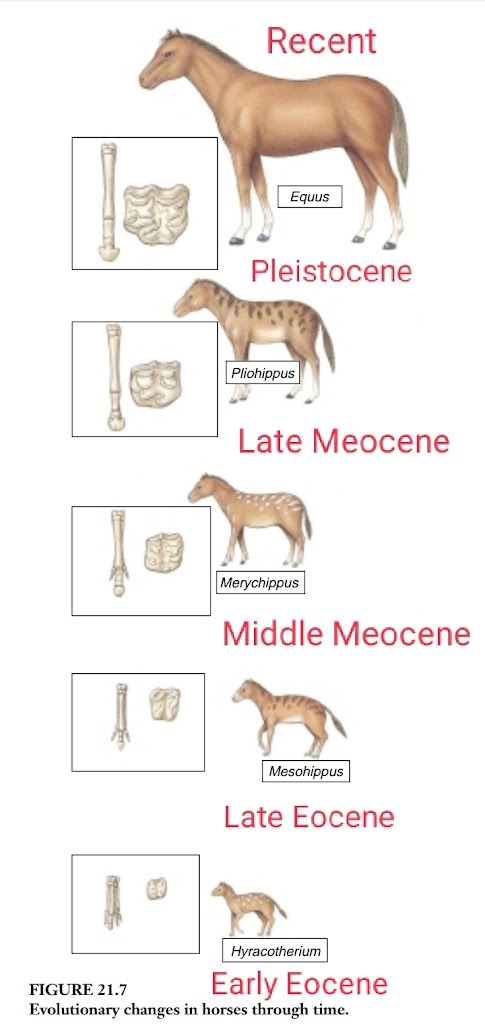
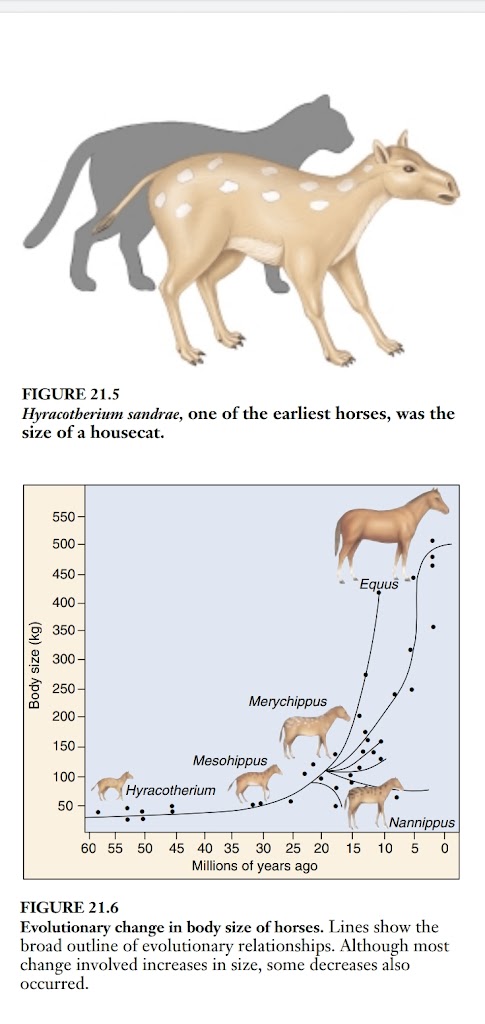
“The first member of the horse family of genus Hyracotherium which was the size of housecat”[ Source-Ch 21 The Evidences for Evolution,Biology, Raven Johnson], small with short legs and broad feet and they probably browsed on leaves and herbs. From the earliest one to modern day horses there are certain changes are occured in variety of traits which are;.
1. Size of the horse.
2. Toe reduction.
3. Tooth size and shape.
 |
| Source- Ch-21 Evidences for Evolution, Biology, Raven Johnson. |
1. Size of horses– The first horses were no bigger than dogs, with some considerably smaller [ Source- ch-21 Evidences for Evolution, Biology, Raven Johnson].
But nowdays the modern horses are wiegh beyond half ton. Fossil record reveal that there is a changes in size i.e. increase of size can be seen over a period of 30 million years. However, trends towards decrease in size also exhibit among some branches of the equid evolutionary tree.
2. Toe reduction– The feet of modern horses have a single toe, enclosed by a tough bony hoof. In contrast to that Hyracotherium had four toes at its forefeet and three toes on its hindfeet, and the toes were encased by fleshy pads unlike hooves in modrn horse’s toes.
By considering the fossil records,it can be clearly seen that with transition of time there is a increase in length of the central toe, development of bony hoof and reduction of toes are some striking feature which are easy to perceive. Along with these changes there were other changes occured in the same line i.e. changes in length and structure of limbs (skeletal structure) enable the animals to run longer distances at higher speeds.
3. Tooth size and shape– The teeth of Hyracotherium were small and relatively simple in shape, with time there is changes in length of the teeth and developed a complex pattern of ridges in molars and premolars. This featured enables the horses to chewing tough and gritty vegetation, along with this pattern of changes to maintain the continual chewing with great strength the skull shape also get changed conventionally.
Evolutionary Trends:
 |
| Source- Ch-21 Evidences for Evolution, Biology, Raven Johnson. |
Considering the evolutionary trends in horses some believe that, it is an example of consistent evolutionary changes through time and interpret with the help of fossil record that ,it is progressive, guiding force, consistently pushing evolution in a single direction, but actually this is not the case, we know that evolutionary process is not unidirectional or progressive in nature. It is variable and non-uniform by its nature through time. It contains the periods of rare changes and great changes, therefore trends exhibited in horse evolutionary trees are of simmilar pattern which can be seen as simultaneously in some lineages.