Introduction :
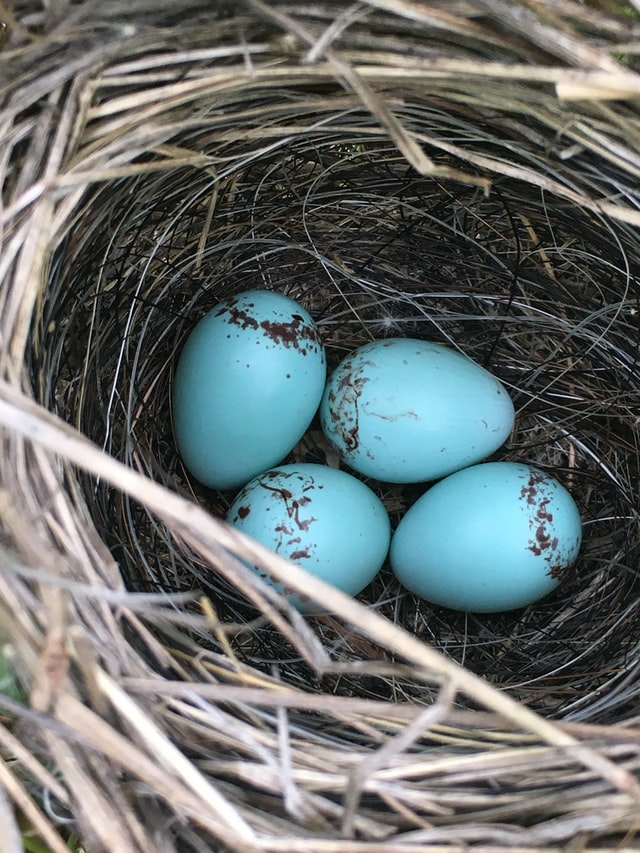
The fully developed female sex cell is know as egg. The eggs of different animals varied widely interms of size, arrangement of yolk and thier covering.
Types of animal eggs : Animals eggs can be classified according to following criteria.
1. Amount of the yolk.
2. The distribution of yolk.
3. The presence and absence of cells.
4. The type of development.
 |
| Source- |
1. Based on amount of yolk :
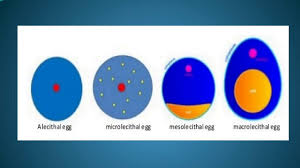
i) Microlecithal eggs- The eggs which contain small amount of yolk are known as microlecithal eggs or alecithal eggs or oligolecithal eggs.
e.g. Amphioxus, Tunicates, and Eutherian mammals.
ii) Mesolecithal eggs-
 |
| Source- studentreader.com |
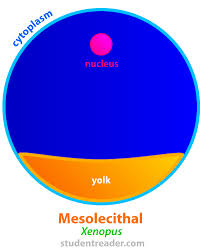
The eggs which contain moderate amount of yolk are known as Mesolecithal eggs.
e.g. Petromyzontia, Dipnoi, and Amphibia.
iii) Megalecithal eggs- Macrolecithal or polylecithal eggs- the eggs which contain huge amount of yolk are known as Megalecithal eggs.
e.g. Reptiles, Birds, and Prototherians mammals.
2.Based on distribution of yolk :
i) Isolecithal or homolecithal eggs-
 |
| Source- studentreader.com |
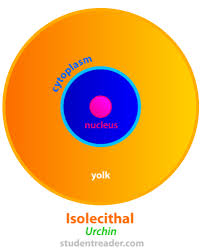
In Isolecithal eggs the yolk is evenly distributed all over the cytoplasm.
e.g. Sponges, Amphioxus, Tunicates, and Eutherian mammals.
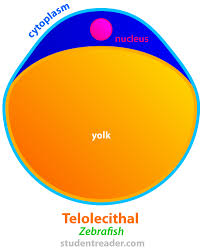
ii) Telolecithal eggs-
 |
| Source- student reader.com |
The yolk is unevenly distributed and more concentrated at vegetal pole (opposite to animal pole having nucleus).
e.g. Annelids, Molluscs and many Amphibians.
iii) Centrolecithal eggs- The quantity of yolk is huge and concentrated at the centre of egg cytoplasm. Cytoplasm is spread as a clear layer around the periphery of the yolk and the nucleus positioned at its centre.
e.g. Arthropods
iv) Discoid eggs- This type of egg contains large amount of the yolk. Yolk occupies the largest position of the egg except a small disc shaped area of the cytoplasm known as Blastodisc. The blastodisc is found at the top of the yolk mass.
e.g. Reptiles, Birds, and Prototherians mammals.
3. Based on presence and absence of cells :
i) Cleidoic eggs- Cleidoic means container like. The eggs of reptiles and birds become self contained and fully loaded with yolk. These eggs are covered by thick and hard shell of protection.
e.g. Reptiles and Birds
ii) Non-cleiodic eggs- These type of eggs are not covered with shell.
e.g. All viviparous animals and oviparous animals who lay eggs in water and development is internal in nature.
4. Based on type of development :
i) Determinate or mosaic eggs- During the process of development in some animals the fate of every part of the egg is fixed having no change in it. Before or at the time of fertilization the head-tail, right- left and dorsal-ventral axis of the future embryo are predetermined in the zygote. If certain portion of the egg is removed experimentally , then the developing embryo will not develop that particular organ. Therefore this type of egg is called determinate or mosaic egg. Where the fate of egg cannot be alter after fertilization.
e.g. Polyclads, Nemerteans, Ascidian, Annelids and Molluscs.
ii) Indeterminate or regulative eggs- In this type of egg, there is no predetermination and the fate of various area of the egg is not usually fixed untill first three cleavages have started. If the blastomere develops as a whole embryo.
e.g. Echinoderms, Deuterostomes .
Egg Membranes :
Egg membrane is the layer which covers the egg cell. The eggs are well protected by egg membranes. Egg membranes are absent in Sponges and Coelenterates. All animals egg except Cnidaria’s eggs are enclosed by a membrane called the vitelline membrane, it comprising of mainly protein fibres and protein receptors needed for sperm binding during fertilization.
By the time egg reaches maturity the egg develops membranes ,which protect it from chemical or physical injury. In some animals they act as barrier to multiple sperm penetration. Not all animals have same type of egg membranes, they are generally classified according to thier origin. The membranes are produced either by the egg itself or by the follicle cells of the ovary or by the oviduct of the female. Therefore the following classification can be made for thier easy understanding.
1. Primary membranes
2. Secondary membranes
3. Tertiary membranes
1. Primary membranes:
These membranes develop in the ovary, between the oocyte and follicle cells around the plasma membrane. Primary egg membranes are secreted either by follicle cells or by oocyte and sometimes by the contribution of both. The primary membranes have different structure in different animals. They are of following types;
a) Vitelline Membrane- In some animals egg primary membrane is known as Vitelline membrane. It is very thin and transparent and contains mucopolysaccharides and fibrous protein. The space between Vitelline membrane and the plasma membrane is called Pervitelline space, commonly found in eggs of Insects, Echinoderms, Amphibians, Birds etc.
b) Chorion- It is found in the egg of lower chordates like Teleost fishes. It is a product of surface ooplasm.
c) Zona Radiata- The primary membrane of egg of the shark, some bony fishes, some amphibians, and some reptile has a radiated appearance produced by the surface of ooplasm called zona radiata.
d) Zona Pellucida- It is a glycoprotein layer surrounding the plasma membrane of the mammalian oocyte secreted by follicle cells.
2. Secondary membranes :
The secondary membrane is formed as a basement membrane by a layer of the follicle cells that surround the ovum. These membranes are usually tough and impermeable. The secondary membranes are as follows;
a) Chorion- This is a common outer covering in the eggs of insects, ascidian and cyclostomes. It is found,outside the vitelline membrane. As the Chorion is tough and impermeable, it is provided with one or more openings called micropyles through which the sperms enter into the egg.
b) Corona Radiata- It is found in mature mammalian eggs around the ovum outside the zonapellucida. The membrane is formed by columnar,radially arranged layer of follicle cells.
3. Tertiary membranes :
The tertiary membranes are secreted by the cells of oviduct when ovum moves through the oviduct.
a) White Albumin- It surrounds the vitelline membrane, found in egg of hen. It is formed of three uniform layers- an inner less dense albumin, a middle dense albumin, and an outer less dense albumin. The albumin is formed of water and protein.
b) Shell Membrane- The shell membrane is formed arround the albumin in the egg of hen. It is double membrane, the two membranes adhere closely and are separated by an air space at the blunt end of the egg. The membrane is formed of Keratin.
c) Shell- The shell is the outer covering of land animal’s egg. It is formed of calcium carbonate. It is white or brown in colour. It contains as many as 7000 minutes pores. These pores are 0.04 to 0.05 mm in diameter. They are filled with a proteinous substance called collagen.
d) Jelly Coat- The amphibians eggs are surrounded by a gelatinous covering called jelly coat. The jelly envelops holds the eggs together in masses or strads, protect the eggs from infections, insulate the eggs, make them unappetizing (tasteless) to predators and settled the eggs with twigs and plants for restrict the movement of eggs, it also help in fertilization.